
LET'S TALK ABOUT YOUR POOL
A better pool starts with a clear conversation
Share your location, timing and project type so our team can give you a useful first response.
DIRECT CONTACT
Talk to PebbleTec Thailand
Phone
+66 65 664 6712
info@pebbletecthailand.com
Service area
Phuket and projects across Thailand
Tell us about your project
Complete the details below and our team will follow up to discuss the next step.
Frequently asked questions
Pool finish and water care
How do I care for my pool?
With the ownership of a new pool comes the responsibility of maintaining proper water chemistry. Maintaining proper water chemistry is essential to preserving the aesthetic beauty of your pool finish, as well as attaining the expected longevity of the finish. After 30 days, the pool water must be maintained at all times per the National Plasterers Council’s recommended ranges for pH, carbonate alkalinity, calcium hardness, cyanuric acid/stabiliser and total dissolved solids. For saltwater pools (SWCGs), be sure to follow PTI’s specific “Start-up and Maintenance Procedures” instructions.
Why is there a disclaimer associated with finishes that contain seashell?
Select finishes may contain seashell pieces such as abalone and mother of pearl that are made from minerals in seawater by living mollusks. Under certain unfavourable conditions, such as that of aggressive water chemistry, the shells may lose some of their lustre and sparkle over time. With proper maintenance and care of your pool, the lustre of the shell should last for years.
Why does the water colour of my pool look different from what I expected?
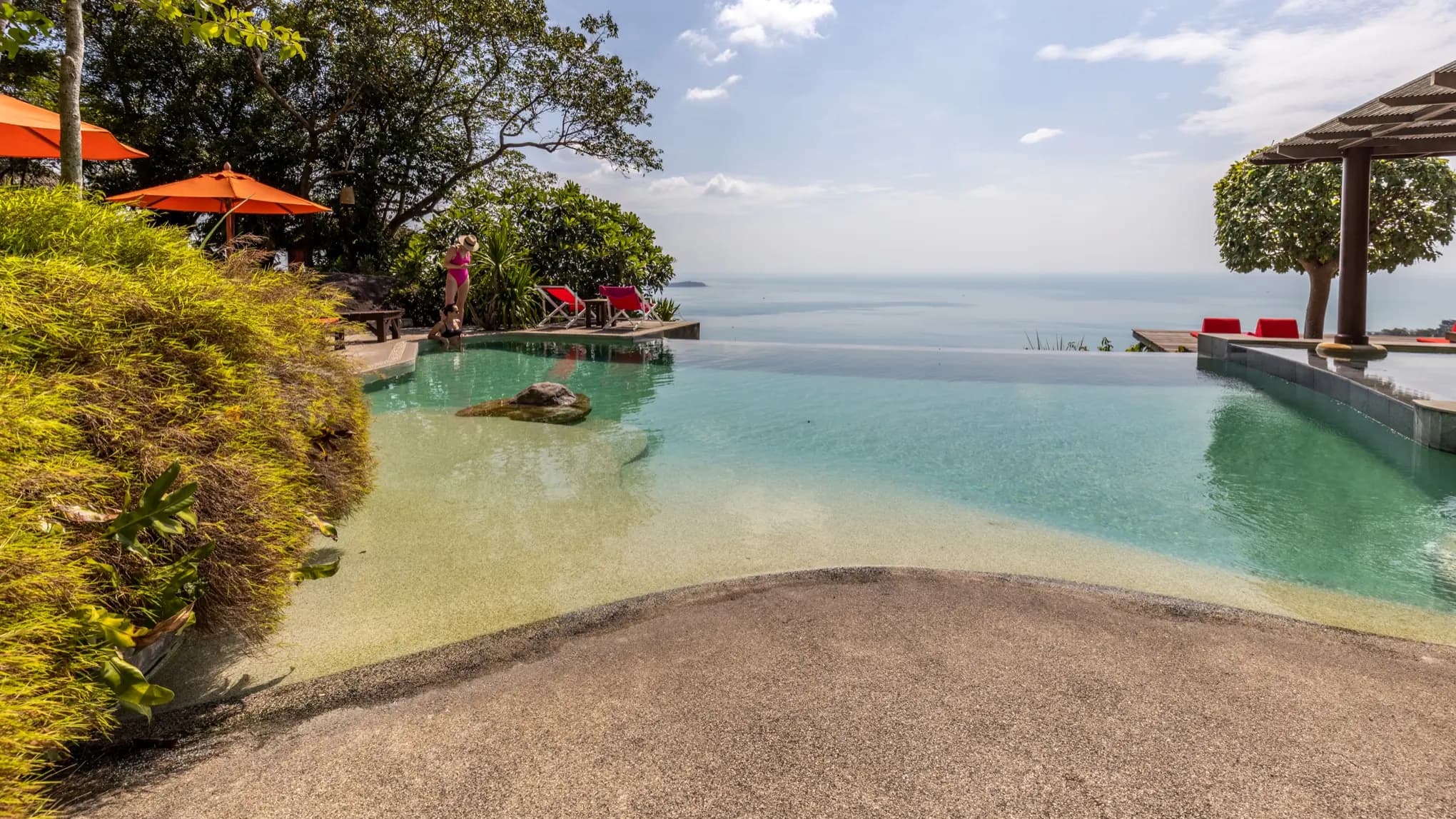
There are many factors that influence the final pool water colour including, but not limited to: pool depth, day time sun exposure, night time lighting placement, trees and landscaping, decking material and water features (i.e., fountains, jets etc.) Even water chemistry and filtration can affect water colour. PTI cannot guarantee that a product sample or image will be an exact match to your finished pool for these reasons. In all cases, allow time for the initial curing process (approximately 30 days) before judging the finish or colour.
Will my pebbles fall out over time?
It is normal for pebbles to come loose during the initial curing process. It is also normal to see some small loss of pebbles over time. Maintaining proper water chemistry is crucial to preserving the integrity of the finish. If water chemistry is not properly balanced, the cement may weaken over time, and the pebbles may come loose in larger amounts.
What does it mean if my pool water is under “aggressive chemical attack”?
According to the National Plasterers Council, cementitious surface coatings are susceptible to chemically aggressive swimming pool water or to any chemical that may deteriorate the cementitious materials of a surface coating. Swimming pool water that is not in the ideal range of acceptable tolerance (or “balanced”) as in accordance with the ANSI/APSP Standards 3 and 4, is considered detrimental to cementitious surface coatings. Depending on the direction of the imbalance, a coating can either be stained or etched. Often, both staining and etching are exhibited on the surface of a coating as the pool water fluctuates from one extreme to the other. Visible signs of salt crystallization, surface efflorescence, or cracks that are emitting efflorescence or salt deposits are common to a coating in contact with a positive saturation index (+ LSI), or “scaling” condition. If the water is capable of leaching cement compounds from within the surface coating, then that water is in a negative saturation index (─ LSI), or “aggressive” condition. If care is not taken to ensure that the water of a swimming pool is kept in an Ideal Range that is considered by ANSI/APSP Standards to be “balanced”, and further that a sufficient amount of carbonate alkalinity buffer is constantly present, then the cementitious surface coating will be susceptible to damage from that water– and deterioration may result. Water-soluble salts, acids, or ions such as sulfates, chlorides, and carbonates, can be transported into a cementitious surface coating and react with the cementitious compounds. The resulting chemical reaction between the cementitious compounds and these salts, acids, or ions, in the presence of water, can cause deterioration to the coating. Acidic water aggressively attacks and dissolves cementitious surface materials. Water that is low in hardness, or soft water, can cause leaching of certain compounds of the cement, especially calcium hydroxide. A cementitious surface coating that is in contact with water in a negative saturation index (LSI) condition will typically show some type of etching damage to the surface of the coating over time. Often etching, staining, and salt deposits are seen on the surface coating if the water has fluctuated between positive saturation index (LSI) and negative index (LSI) conditions. Please visit the National Plasterers Council website at https://www.nationalplastererscouncil.com/water-chemistry/ for more information.
How long should I wait until I enter my newly filled pool?
You should never enter an empty pool. We recommend that you wait until the pool is completely finished and filled, with the water chemically balanced, before you start enjoying it. The National Plasterers Council further states: “At no time should any person or pets be allowed in the pool during the fill. Do not allow any external sources of water to enter the pool to help prevent streaking. It is recommended that you do not swim in the pool until the water is properly balanced, sanitized and there is no more loose plaster dust from brushing; however, entering the pool once it is filled with water will not harm the finish. Please visit the National Plasterers Council website for more information on water chemistry at https://www.nationalplastererscouncil.com/water-chemistry/
Now that my pool is full of water, how much brushing of the pool should I do?
It is recommended that you brush a PTI pool finish three times a day for the first three days and two times a day for the next ten days. Using a standard, nylon (very important) bristled pool brush, brush the walls and the floor of the finish toward the main drain. After that, regular maintenance may include brushing the pool approximately once per week, depending on the amount of dust or debris that may fall into the pool. By consistently brushing the interior surface of your swimming pool, you will prevent algae buildup, remove dirt particles, and smooth the surface to ensure a long lasting, beautiful finish.
What types of brushes are okay to use with PebbleTec finishes?
During the initial start-up of your new pool, a nylon pool brush is recommended for brushing the finish because it is less aggressive to the surface than other brush types. After the curing process is complete, most pool brushes may be safely used with our finishes. More aggressive pool brushes such as stainless steel brushes can be used to treat certain types of build-ups and staining but are not recommended for daily use due to their aggressive nature.
Do the additives such as Shimmering Sea and Luminous have a big effect on the water colour?
Additives such as the Shimmering Sea (shell) and Luminous (glass beads) are meant to serve as accents to the overall look of the finish. These items will give a more premium, elegant look to the finish and extra sparkle to the water–but will not have a huge influence on the water colour itself.
Should I be concerned if I over-chlorinate or over-shock my pool?
Don’t over-chlorinate or over-shock the pool. Adding too much chlorine or shock can cause the fading of the colour of the finish. Daily chlorine and periodic chlorine shock should not be used interchangeably when balancing your water chemistry. Shock treatments should be used only as an occasional supplement to daily chlorine usage, used to break down the resistance of algae and to remove chloramine (a chlorine by-product).
Should I do anything immediately after adding chemicals to the pool?
Always brush the entire surface of the pool after adding chemicals. This ensures that the chemicals are properly dispersed and not allowed to harm the finish. Add chemicals by broadcasting them around the pool and brushing until thoroughly dissolved and/or dispersed. Slower dissolving chemicals like stabiliser (CYA), calcium increaser, and alkalinity increaser can be added to the skimmer, while the pumps are running continually, until the chemicals have completely dissolved and/or dispersed. Over time, it is not uncommon to see some colour shading in a fan-like pattern radiating outward from around pool returns where the water is circulating with greater force. Regardless of the water chemistry, the increased water pressure and often an increased concentration of chemicals can cause greater staining or erosion to occur in these areas.
Why do I see some small shrinkage/hairline cracks in my finish?
It’s not uncommon for a few small check cracks (closed shrinkage cracks) to occur on the upper steps and benches. This is a natural characteristic of any cement-based material. In most cases, these hairline cracks will seal up naturally once you have filled the pool with water. Cracking is not something that is covered under our Limited Warranty.
Is it normal to see some waviness or ripples in my pool finish, especially at night?
It’s not uncommon to see ripples or slight undulations across the floor of the pool. These can be exaggerated at night, as lighting may expose imperfections that are otherwise not seen in the daytime. (Daytime sun shines down onto the finish surface from above, while the pool light shines horizontally across the surface.) This same effect can be observed by laying a flashlight onto the surface of a driveway or sidewalk at night. Because this is a normal phenomenon, imperfections identified through this method are not covered under our Limited Warranty. Visit the National Plasterers Council website at https://www.nationalplastererscouncil.com/resources/ for more information.